
STRATEGIC INVESTMENT PARTNERSHIP
CREATING A VERTICALLY INTEGRATED ADVANCED ENGINEERING & MANUFACTURING PLATFORM HERE IN THE BRITISH ISLES.
MCM ENGINEERING GROUP is developing a vertically integrated advanced engineering and manufacturing platform the combines R&D, engineering design, additive manufacturing, composite technologies and precision manufacturing within a single organisation By integrating these capabilities, the company aims to support Defence, Aerospace, Maritime, Select Motorsport and other high-value industries with advanced lightweight engineering solutions.
HEADQUARTERED IN THE UNITED KINGDOM
OUR BUSINESS MODEL IS VERTICAL INTEGRATION

ALL OPERATIONS IN IRELAND
OUR TARGET SECTORS ARE ; DEFENCE, AEROSPACE, MARITIME AND MOTORSPORT
SEEKING £650,000 / €760,000 IN STRATEGIC INVESTMENT
Supporting the establishment of an advanced engineering and manufacturing capability serving strategically important industries across the British Isles.
Why Partner with MCM ?
-
![Close-up of a U.K. flag waving against a dark blue sky, with part of the European Union flag visible at the bottom.]()
✽
Cross-Border Engineering
Headquartered in London with operations set for County Wexford, MCM.EG combines UK leadership with Irish manufacturing capability to serve domestic and international markets.
-
![Close-up of a blue drill bit drilling into a metallic surface with a pattern of holes.]()
✽
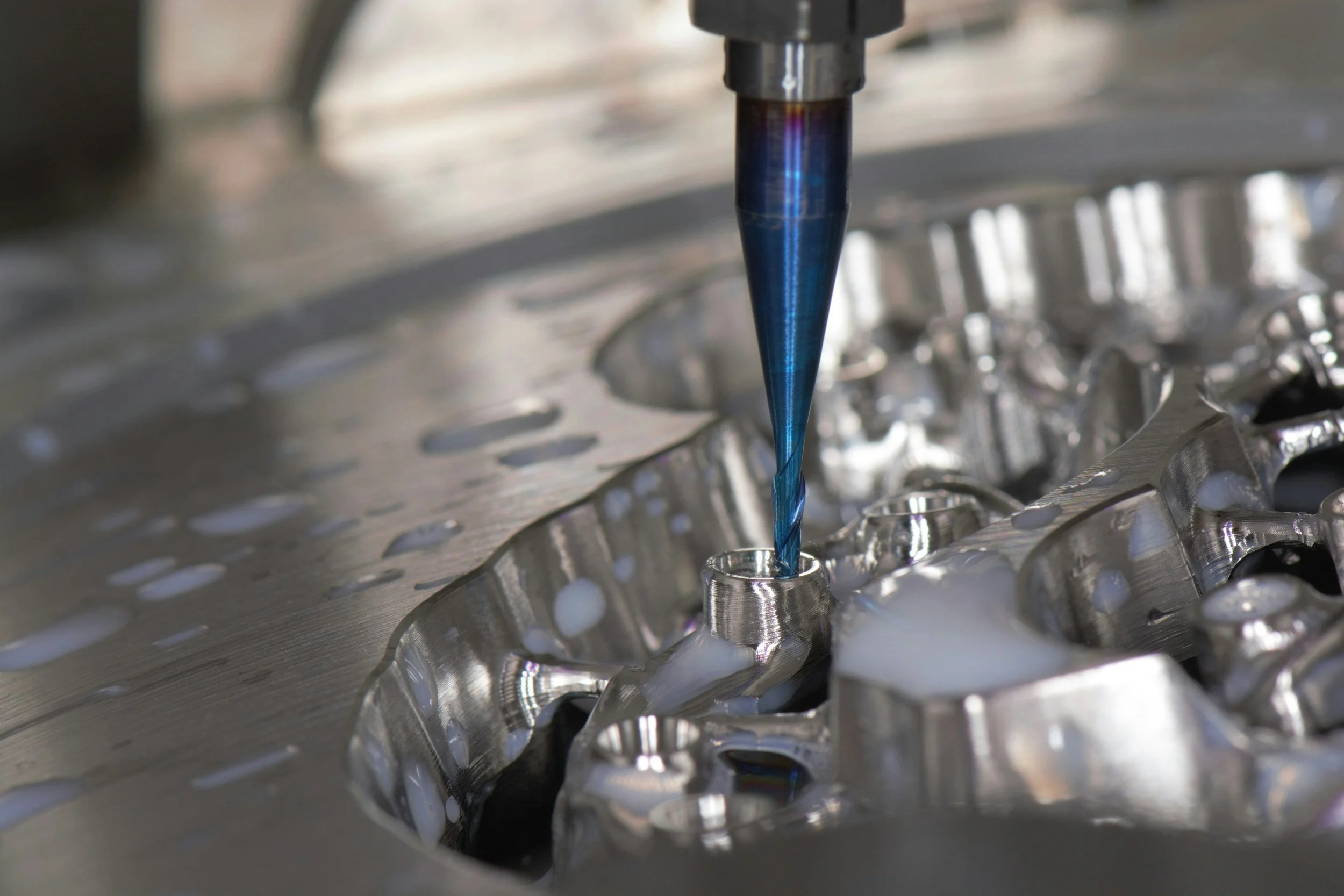
Advanced Manufacturing
Strategic Investment supports the expansion of composite engineering, industrial additive manufacturing, precision CNC machining and low-volume production.
-
![Two person hands holding metallic lattice structures and 3D printed objects with intricate geometric patterns, all wearing white gloves.]()
✽
Research & Innovation
MCM is committed to advancing manufacturing technologies through collaboration, applied research and engineering-led innovation.
-
![A rocket launch showing a bright trail ascending into the sky at dusk, with smoke and flames visible at the base. The sky transitions from a light pinkish hue near the horizon to a deep blue higher up, over a flat landscape near a large body of water.]()
✽
Scalable Industrial Growth
Our strategy is centralised on building a vertically integrated manufacturing facility capable of supporting programmes from concept through to production.
-
![Flags of the European Union, Georgia, and NATO hanging from a building, with trees and a balcony in the background.]()
✽
International Outlook
While rooted in the UK and Ireland, MCM is developing capabilities to support OEM’s, defence organisations, research institutions and industrial partners worldwide.
-
![Snow-capped mountain peaks bathed in warm, orange sunlight at sunset or sunrise, under a clear blue sky.]()
✽
Long-Term Strategic Partnerships
We seek investors and partners who share our ambition to build a globally recognised advanced engineering business.





Exploring the opportunity
THE STRATEGIC LANDSCAPE
The global engineering landscape is undergoing a period of unprecedented transformation with Industry 4.0. Rising Defence expenditure, increasing investment in sovereign industrial capability and accelerating adoption of advanced manufacturing technologies are reshaping the industries MCM ENGINEERING GROUP has been established to serve. Understanding these trends provides important

GLOBAL DEFENCE EXPENDITURE
WHY IS DEMAND FOR ADVANCED ENGINEERING CAPABILITY CONTINUING TO GROW ?
WHY IT MATTERS
Global defence expenditure reached a record US$2.72 trillion in 2024, representing a 37.4% increase since 2015 and marking the tenth consecutive year of growth. Annual spending rose by 9.4% between 2023 and 2024 alone, reflecting sustained investment in defence modernisation, advanced technologies and industrial capability. As governments continue to strengthen national security and supply chain resilience, demand for advanced engineering and high-performance manufacturing is expected to remain a long-term strategic priority.
Source:
Stockholm International Peace Research Institute (SIPRI), Trends in World Military Expenditure 2024.
INVESTMENT IN ADVANCED ENGINEERING CAPABILITY
WHAT LEVEL OF LONG-TERM INVESTMENT IS SUPPORTING ADVANCED ENGINEERING ACROSS IRELAND, THE UK AND EUROPE?
KEY INSIGHT
Governments across the British Isles and Europe are making sustained long-term investments to strengthen industrial capability, defence readiness and technological innovation. The United Kingdom’s Ten-year Defence Equipment Plan, Irelands National Development Plan, Horizon Europe, the UK National Wealth Fund and the European Defence Fund collectively represent more than £540 Billion of strategic investment alone. Allocated to support infrastructure, innovation, industrial ecosystems in which advanced engineering businesses operate. These programmes are helping create sustained demand for organisations capable of developing and manufacturing high-value engineering solutions
Source:
UK Ministry of Defence - Defence Equipment Plan 2024-2034
Government of Ireland - National Development Plan 2021 -2030
European Commission - Horizon Europe 2021-2027
UK Government - National Wealth Fund
European Commission - European Defence Fund 2021-2027
defence & industrial innovation priorities
WHICH ENGINEERING CAPABILITIES ARE BECOMING STRATEGICALLY IMPORTANT ACROSS DEFENCE & ADVANCED MANUFACTURING
KEY INSIGHT
Defence and advanced industrial strategies are increasingly focused on developing sovereign capability in advanced manufacturing, materials engineering, digital systems and resilient supply chains. These priorities reflect a shift from traditional procurement models towards the development of integrated industrial ecosystems capable of designing, producing and sustaining complex technologies. For engineering organisations operating across defence, aerospace and high-performance manufacturing sectors, these trends create opportunities to support programmes requiring advanced materials, lightweight structures, precision manufacturing and rapid innovation cycles.
SOURCES:
UK Ministry of Defence - Defence Industrial Strategy
NATO - Emerging and Disruptive Technologies Priorities
European Commission - Defence and Industrial Capability Programmes
Government of Ireland - Defence and Enterprise Strategies
MEAsured benifits of integrated engineering
CAN ENGINEERING INTEGRATION IMPROVE PROGRAMME PERFORMANCE ?
KEY INSIGHTS
Published research by the National institute of Standards and Technology has shown that organisations implementing concurrent and integrated engineering methodologies achieved measurable improvements across multiple performance indicators.
Case studies involving major defence contractors reported reductions in development time of up to 60%, project cost of up to 60%, product defects of up to 80% and manufacturing scrap and rework of up to 75%. The conservative values shown (right) illustrate the lower end of these reported improvement, demonstrating how greater engineering integration can improve programme efficiency and delivery performance.
SOURCES:
National Institute of Standards and Technology (NIST)
NIST - Concurrent Engineering Through Product Data Standards
NIST - Supporting Research into Concurrent Engineering and Integrated Product Development
industry challanges & market opportunity
“THE FUTURE OF ADVANCED ENGINEERING WILL BE DEFINED NOT ONLY BY WHAT COMPANIES MANUFACTURE, BUT BY HOW EFFICIENTLY THEY INTEGRATE THE ENGINEERING PROCESS”
As engineering programmes become increasingly sophisticated, the traditional model of using multiple independent suppliers across the product lifecycle introduces greater complexity, longer development cycles and increased programme risk. Independent research has consitantly demonstrated that integrating engineering, manufacturing and production activities can significantly improve programme performance, particularly within defence, aerospace and other high-value engineering sectors.

the cost of late engineering changes
WHY IS EARLY ENGINEERING INVOLVEMENT CRITICAL TO PROGRAMME SUCCESS ?
KEY INSIGHTS
Engineering research consistently demonstrates that the cost of implementing design changes increases dramatically as a programme progresses. Modifications identified during the concept phase can often be incorporated with minimal impact, where as the same changes introduced during production or in-service operation may require redesign, tooling modifications, production disruption and revalidation. This exponential increase in cost reinforces the importance of integrating engineering, manufacturing and production considerations as early as possible within the development cycle.
SOURCES
NASA Systems Engineering Handbook
INCOSE Systems Engineering Handbook
NIST - Concurrent Engineering Through Product Data Standards
The earlier engineering challenges are identified, the lower the impact on programme cost, schedule and technical risk.
MCM.EG - BUILT WITH INTENT
WE BELIEVE THE NEXT GENERATION BELONGS TO INTEGRATED ENGINEERING.
MCM ENGINEERING GROUP has been established around five engineering principles that believe will define the next generation of advanced manufacturing businesses. These principles will guide our investment decisions, capability development and long-term strategy.

ENGINEERING FIRST
Competitive advantage is increasingly created during engineering, where decisions determine performance, manufacturing and lifecycle cost.
01

INNOVATION MATtERS
Bringing critical engineering disciplines together reduces complexity, improves collaboration and supports more efficient programmes delivery.
02
LIghTweight wins
Advanced materials and composite technologies continue to replace conventional structures across high-performance applications.
03
CApability is resilience
Organisations with broad in-house capability are better positioned to respond to changing customer requirements and evolving strategic priorities.
04
Manufacturing must adapt
Digital manufacturing, automation and additive technologies are reshaping how complex engineering products are designed and produced.
05
some companies need capital. others need partners.
MCM ENGINEERING GROUP IS BEING BUILT ALONGSIDE PEOPLE WHO CAN CONTRIBUTE MORE THAT INVESTMENT ALONE. WE VALUE STRATEGIC INSIGHT, ENGINEERING AND MANUFACTURING EXPERTISE, COMMERCIAL LEADERSHIP AND MEANINGFUL INDUSTRY RELATIONSHIPS JUST AS HIGHLY AS CAPITAL.
ALONGSIDE PRIVATE INVESTMENT, WE ARE ACTIVELY PURSUING NON-DILUTIVE INNOVATION FUNDING THROUGH PROGRAMMES SUCH AS DASA AND INNOVATE UK AS A PART OF A DISCIPLINED CAPITAL STRATEGY.
IF YOU SEE VALUE IN BUILDING BUSINESS THIS WAY, WE’D BE PLEASED TO DISCUSS OUR INVESTMENT MEMORANDUM AND BEIGIN THE CONVESTATION